
Using the “Strike for Cause” Method to Select Criminal Juries in Texas
- November 2nd, 2026
- Cheryl McGirr
- Comments Off on Using the “Strike for Cause” Method to Select Criminal Juries in Texas
The Critical First Defense in Texas Criminal Courts
Facing criminal charges in Travis, Williamson, or Hays County is one of the most stressful experiences anyone can have. Under the U.S. Constitution and the Texas Code of Criminal Procedure, every defendant enters the courtroom with the fundamental right to be presumed innocent until proven guilty beyond a reasonable doubt.
However, in reality, many prospective jurors enter the jury box with implicit biases. From the common misconception that “if someone was arrested, they must have done something,” to skepticism surrounding a defendant’s decision not to testify, unaddressed biases can jeopardize a fair trial before opening statements even begin.
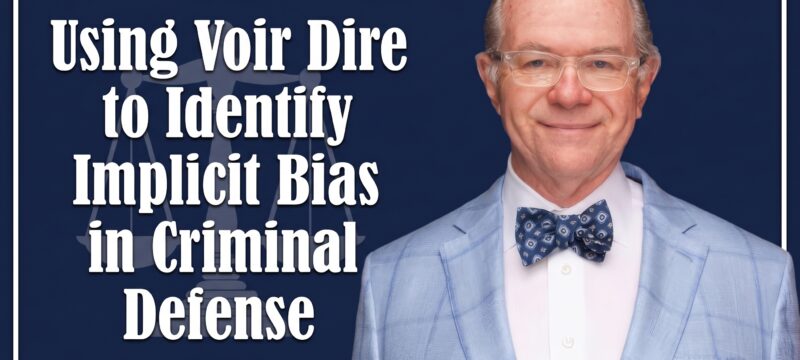
At McGirr Law, we recognize that protecting your constitutional rights starts during jury selection (voir dire). In a recent episode of the Texas Lawyer Podcast, host Cheryl McGirr sat down with legendary jury consultant and witness-preparation expert Robert Swafford to discuss how defense attorneys can uncover hidden juror bias and safeguard the presumption of innocence.
Here is how strategic voir dire identifies implicit bias and protects criminal defendants in Central Texas courtrooms.
The Trap of “Selling Your Case” vs. Uncovering Real Attitudes
Traditionally, many lawyers approach voir dire as a miniature opening statement—attempting to “sell” their case, lecture the jury panel, or secure quick verbal agreement on abstract legal principles. As Robert Swafford explained on the Texas Lawyer Podcast, this approach misses the entire purpose of jury selection.
Instead of lecturing prospective jurors, effective defense attorneys utilize the Socratic inquiry method pioneered by legendary jury consultant Cathy Bennett:
- Ask Open-Ended Questions: Rather than asking leading questions, ask open-ended questions about attitudes toward law enforcement, the Fifth Amendment, and the burden of proof (e.g., “What are your feelings about a defendant choosing not to take the stand?”).
- Practice Active Listening: Allow jurors to speak without interruption, drawing out their genuine beliefs and personal experiences.
- Respect Inherent Bias: Everyone arrives with implicit biases shaped by lived experience. The goal of voir dire is not to lecture jurors out of their biases, but to uncover those attitudes so they can make fair decisions.
Challenging the “Where There’s Smoke, There’s Fire” Mentality
In criminal proceedings, one of the most pervasive implicit biases is the assumption that law enforcement officers do not make mistakes or that an indictment implies guilt.
During voir dire, defense counsel must create a safe space for prospective jurors to admit these subconscious assumptions. By asking follow-up questions such as “Tell me more about that” or “What I hear you saying is…”, attorneys can identify jurors who, despite their best intentions, cannot set aside their personal beliefs to remain truly impartial.
When a juror acknowledges that they would require the defense to produce evidence of innocence—rather than holding the prosecution strictly to its burden of proof beyond a reasonable doubt—the presumption of innocence is actively threatened.
The “Strike for Cause” Method: Preserving Strategic Leverage
In Texas felony cases, defense attorneys receive a limited number of peremptory strikes to remove prospective jurors without stating a reason. If an attorney relies solely on peremptory strikes to eliminate biased jurors, those strikes run out quickly.
To overcome this limitation, Robert Swafford developed the Strike for Cause Method:
- Identify Disqualifying Biases: Ask targeted, respectful follow-up questions that allow biased jurors to clearly state their fixed opinions.
- Establish Legal Cause: When a juror candidly admits that their personal beliefs or experiences prevent them from being completely fair and impartial under Texas law, they can be struck for cause.
- Conserve Peremptory Strikes: Getting biased jurors struck for cause preserves your limited peremptory strikes for borderline cases, giving the defense maximum tactical leverage during jury selection.
In Closing
A strong criminal defense requires more than contesting evidence in court—it requires ensuring the twelve individuals in the jury box can uphold the presumption of innocence. At McGirr Law, we combine deep knowledge of Texas criminal law with advanced trial psychology to protect our clients’ rights at every stage of litigation.
🎥 Want deeper insights on this topic? Watch our full interview with Robert Swafford on The Texas Lawyer Podcast on YouTube: Watch Episode 14 on YouTube
Take the Next Step with McGirr Law
If you or a loved one are facing criminal charges in Travis, Williamson, or Hays County, contact McGirr Law today to schedule a confidential consultation with our experienced legal team.